Two hospice nurses caring for a patient in bed holding hands
  • 5802 Story Headers (1)

    “Hospice Chose Me” – Malita Williams

    Staff Spotlight on SSD & Social Worker Malita Williams

    She’s a Fierce Advocate who knows How to Laugh

    This National Social Work Month we shine a second spotlight on Dayton SSD Malita Williams, MSW.

    When a friend suggested that Malita Williams would excel as a social worker in hospice, she immediately answered: "Absolutely not." Seven years later, Malita’s compassion and commitment impact the care patients and families receive at Crossroads in Dayton and her job satisfaction is at an all-time high. 

    5802 Story Headers (1)

    “Hospice Chose Me” – Malita Williams

    Staff Spotlight on SSD & Social Worker Malita Williams

    She’s a Fierce Advocate who knows How to Laugh

    This National Social Work Month we shine a second spotlight on Dayton SSD Malita Williams, MSW.

    When a friend suggested that Malita Williams would excel as a social worker in hospice, she immediately answered: "Absolutely not." Seven years later, Malita’s compassion and commitment impact the care patients and families receive at Crossroads in Dayton and her job satisfaction is at an all-time high. 

    Hospice wasn’t on Malita’s radar screen at all before she joined Crossroads. After completing both a bachelor’s and master’s degree at the University of Cincinnati, she had spent a decade working in child welfare and didn’t yet understand the incredibly important role of hospice for patients and their families. 

    Taking the leap of faith to work at Crossroads led to an unexpected but rewarding experience. “I didn’t choose hospice, hospice chose me,” Malita said.

    Working on both ends of the life spectrum equips Malita with special insight. She said society highly values child welfare and the beginning of life. Now Malita knows that end-of-life care is equally vital. Her hospice patients need just as much support as the children she once served, and she hopes society will one day recognize that.

    Finding Strength in End-of-Life Care

    Malita finds strength in comforting and caring for patients and their families as they navigate the end-of-life journey. She said she loves working for Crossroads, an organization “that truly cares for the people it serves.”

    End-of-life care isn’t without its challenges. Just two years ago, a staff shortage left Malita without any staff social workers. To navigate this predicament, she had to shift her perspective and take on responsibilities beyond her usual role, serving patients directly while administering the overall social work function. She made it work and earned a lot of stripes in the process.


    Fast forward to today. What was once a challenge to juggle with her intense administrative duties has become one of her favorite parts of the job. Reflecting on this experience, Malita describes herself as the kind of person who needs to vent first and then say, “Alright, now what’s the plan?” Currently, there are two open full-time social worker positions in Dayton.

    Malita is married with three small children, ages 9, 4 and 3 who keep her busy beyond words. She finds time to be an active ordained deacon of her church where she is a popular member. 

    Work is extremely important to her, but Malita knows that it is even more important to laugh, have fun, spend time with her family and “love the Lord.” She loves telling jokes and believes people should laugh more.

  • 5906 Green Doors Header

    Get Your Green on in March

    Wait! Crossroads is Always Green

    Another St. Patrick’s Day is in our rear view mirror this week. What a great time to be reminded why the color green is so important to Crossroads Hospice & Palliative Care.

    At Crossroads wearing green has deep meaning. The green we wear every day embodies the ideals of Crossroads’ mission to always “do more” for our patients and their families.

    5906 Green Doors Header

    Get Your Green on in March

    Wait! Crossroads is Always Green

    Another St. Patrick’s Day is in our rear view mirror this week. What a great time to be reminded why the color green is so important to Crossroads Hospice & Palliative Care.

    At Crossroads wearing green has deep meaning. The green we wear every day embodies the ideals of Crossroads’ mission to always “do more” for our patients and their families.

    Our soothing signature sage green color represents life, renewal, energy and spiritual harmony. It inspires and unites team members around our shared promise to provide the best and most compassionate end-of-life care. 

    In our Crossroads green we understand the importance of treating one another with respect and empathy while being deliberately ethical and nurturing in our end-of-life care. This is what Crossroads is known for.

    About St. Patrick’s Day

    St. Patrick’s Day started in the 17th century as a religious observance honoring the saint who brought Christianity to Ireland. Today it is a world-wide secular holiday of revelry and celebration of all things Irish including the color green, the national color of Ireland and shamrocks, a little clover, which is the national plant of Ireland.

  • Path To More

    The “Artificialness” of Intelligence


    By Danny Gutknecht

    We seem to be entering new “eras” more frequently than past generations. And each one assumes it sits at the apex of civilization — that we are somehow more advanced in our thinking than those who came before us.

    The Greeks believed in bleeding patients to cure illness, a practice that lasted well into the 1600s. In 1970s classrooms, children watched films of nuclear annihilation, then were told to “duck and cover” under wooden desks as protection. Progress wasn’t questioned. It was assumed.

    Path To More

    The “Artificialness” of Intelligence


    By Danny Gutknecht

    We seem to be entering new “eras” more frequently than past generations. And each one assumes it sits at the apex of civilization — that we are somehow more advanced in our thinking than those who came before us.

    The Greeks believed in bleeding patients to cure illness, a practice that lasted well into the 1600s. In 1970s classrooms, children watched films of nuclear annihilation, then were told to “duck and cover” under wooden desks as protection. Progress wasn’t questioned. It was assumed.

    The same pattern showed up in the early days of social media. In 2008, 1,000 Twitter followers could get you paid $15,000 for a keynote. The speed from “novice” to “thought leader” accelerated rapidly. We were told, “this will democratize everything.”

    Today, “friending” has become “prompting” - ordinary actions reframed as revolutionary behaviors. And underneath that is a deeper irony: much of what we call new - impermanence, ego, the nature of mind - was already understood in ancient philosophical, religious, and indigenous traditions. Marcus Aurelius was writing about attention and rumination in 170 AD. Now we package it into apps and call it innovation.

    So the question remains: what do we accept as fact today that we will look back on as absurd?

    None of this denies change. We’ve become highly effective at improving comfort. So effective that we now relabel “challenges” as “struggles,” which says more about us than the difficulty itself.

    So what is “intelligence”?

    It may be too easy to call artificial intelligence an oxymoron. A more precise description is synthetic pattern recombination without lived interiority. It reorganizes what has already been expressed. That can be useful, even powerful. But usefulness has a boundary, and that boundary is not well understood.

    Every light casts a shadow. The problem is we don’t see the shadow until we interact with it.

    Used carefully, these systems can reflect structure. They can surface patterns in your language, expose repetition, force vague thinking into something explicit. They can widen the field by compressing access to ideas and perspectives. In that role, they act as a tool for contrast.

    But the sequence matters.

    If you begin with the machine — letting it generate your ideas, your language, your conclusions — you bypass the process that produces a distinct perspective. Individuation doesn’t come from selecting between well-formed options. It comes from confronting something unclear and forming a response.

    There is also a quieter drift. These systems are shaped by aggregated human output and constrained by what is considered acceptable, coherent, and safe. Over time, if you rely on them, your language begins to move toward that center— moving you closer to group think, rather than expressing your unique gifts. 

    And then there is the premature closure of wrapping a neat verbal bow on our thoughts. Clean summaries can feel like understanding. Structured processes can feel like knowledge. But organization is only one form of learning. But what about the unresolved parts? The contradictions, tensions, what doesn’t fit - this is where progress actually occurs. Those are the first things to disappear.

    And yet, the deeper concern may not be intelligence itself, but dis-placement. These systems can simulate understanding without participating in the tension of relationships. If they become a substitute for engaging with conflict, grief, or desire, something essential is avoided. There is no consequence, no resistance, no unpredictability the feedback that gets our resonances really working. The absence of these things matter.

    So, are we mistaking sophistication for wisdom?

    Breaking through our current walls requires attention, but not more output. Most people repaint the wall and assume they are free. But what is needed is already present - in the voices we carry, and in the tensions that don’t resolve cleanly, in what continues to call for a response.

    The question is whether we stay with it.

    Because whatever this is, it cannot be outsourced.

    And it cannot be done without feeling.

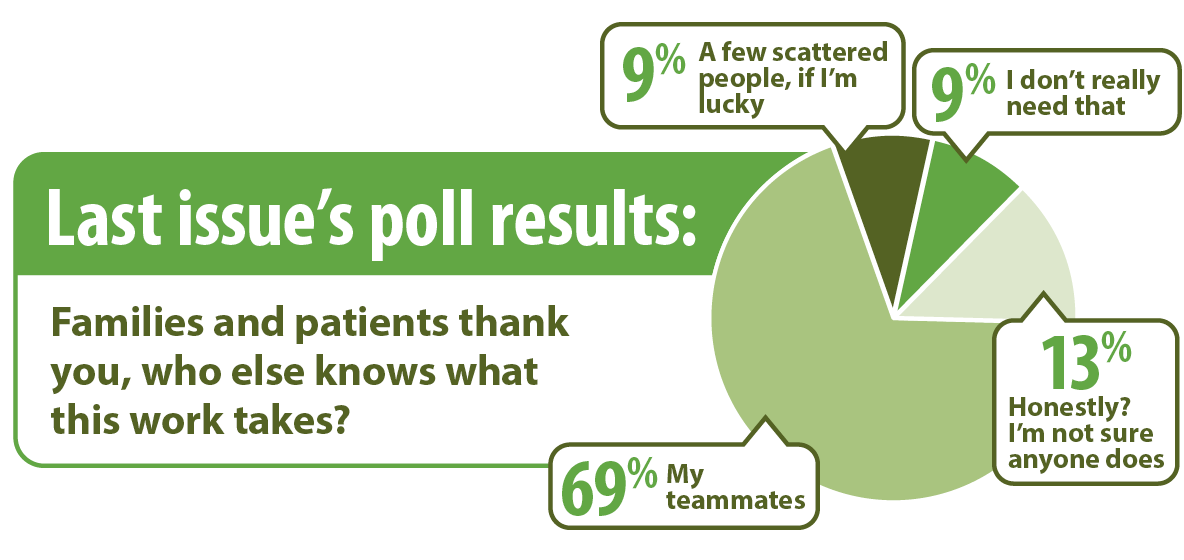
Vital Signs

This week's question:

How do you use AI? (Responses are anonymous and used to help improve the organization.)


WOW!

Why not recognize a coworker for a job well done?

Congratulate February’s WOW! Card recipients:

Cincinnati

Amanda Lester, SSD
Dawn Bradley, SW
Ed Blankenship, PR
Heather Wilkinson, NP
John Reynolds, CH
Kourtney Spears, RNCM
Kristina Wilson, CD
Linda Haywood, Recep
Lindsey Barr, STNA
Liz Wiles, MR
Megan Robertson, RNCM
Michelle Ferrone, Billing
Qiana Gentry, STNA
Shannon Hines, RNCM
Tanya Neumesiter, LPN
Tom Daniels, BC
Veronica Taylor, STNA

Cleveland

Matt Baker, Recep
Sydney Ruppel, HR
Renee Morgan, CD
Diane Cordero, Billing
Nicholas Fenell, SS TL
Debra Wagner, RNTL
Doreen White, RN CM
Virginia Lester, PRN SW
Angelina Munoz, RN QRT 4
Mia Mendoza, SW
Debra Wagner, RN TL
Noah Somerville, RN CM

Dayton

Robert Weisenberger, Assess RN
Faith Richardson, LPN
Leanne Lane, QRT RN
Haleeann Beason, RN CM
Chiquita Berry, TL
Joseph Hamman, Acct
Valencia Gray, VM
Kevin Shurts, QRT STNA
Michelle Jackson, QRT STNA
Angela Kasberg, QRT RN
Linda Homan, QRT STNA
Michelle Deweaver, QRT RN
Maria Lester, RN CM
Tami Jacobs, SW
Tyree Horn, QRT LPN
Cierra Caitlin, DS STNA
Cynthia Brooks, HL
Ibrahim Kumenda, QRT RN
Mark Lafferty, CH
Malita Williams, SSD
Brittany Wiles, NP
Shawnta Parker, QRT STNA

Memphis

Barbara Canada, HHA/DME
Angela Leach, HHA
Mary Dollar-Shapiro, SW
Sandra Jackson, HHA
Barbara Canada, HHA
Claudia Irizarry, Assess RN
Tarjela Miller, RNCM
Tierika Sayles, QRT RN
Sherita Brown, QRT HHA
Joyann Stone, SW
Linda Burnett, BC
Patty Smith, VC

Northeast Ohio

Abigail Phetteplace, STNA
Adriann Winn, LPN
Alexis Woods, RN
Alexus Berger, STNA
Amanda Robin, STNA
Areol Dunlap, STNA
Asir Shamsuddin, STNA
Audra Milbrandt, PR
Ben White, PR
Beth Ann Gratzmiller, STNA
Brandi Harrod, STNA
Brandon Utley, HR
Carolyn Zacapela Diaz, RN
Cartherine Dolohanty, STNA
Cassandra Keller, STNA
Catherine Dolohanty, STNA
Chad Hinkle, HR
Chasity Thacker, LPN
Chris Carter, STNA
Christine Shafer, RN
Clayton Poteet, RN
Connie Shy, RN
Crystal Dykes, TL
Dave Simpson, SW
Dawn Benson, Assess RN
Deanna Eder, SW 
Debra Kirkland, STNA
Deidre Schwietzer, RN
Eli Kleinehnz, RN
Elizabeth Dodd, LPN
Elyse Sikorski, BC
Eric Tiell, STNA
Erika Knopp, ACD
Gabriela Jimenez, STNA
Gabriella Capalingo, STNA
Hallie Leonard, RN
Heather Richmond, RN
Heidi Jacks, STNA
Irina Grbic, STNA
Jackie Roby, RN
Jacob Keller, STNA

Jamie Layton, STNA
Jane Piehl, CH
Jennifer Cafarelli, RN
Jessica Marple, RN
Jessica McCune, NP
Jessica Tomassetti, STNA
Jodi Burroughs, AED
Joe Hardin, STNA
John Morgan, CH
Joy McIntosh, STNA
Kaitlyn Shipe, SW
Kelly Fogel, PR
Kelsey Tilton, RN
Krista Boggs, STNA
Larry Hendrickson, PR
Latonia Branch, STNA
Lori Hazel, TL
Luke Pantelis, LPN
Marianna McLaughlin, RN
Marissa Dupre, STNA
Mary Higginbotham, LPN
Mary Kennedy, RN
Maya Davis, RN
Megan Cox, LPN
Meropi Steve, STNA
Michelle Abel, RN
Mikayla Winter, STNA
Mike Burkhardt, SW
Morgan Gray, LPN
Morgan Norman, RN
Nancy McKean, RN
Olivia Coontz, SW
Renee Morgan, CD
Rhonda Kissner, GOAD
Riley Mizer, RN
Samantha Jacobson, RN
Samantha Simons, STNA
Sara Foster, LPN
Stacey Eisenhart, RN
Stephanie Huth, STNA
Stephanie Killen, RN
Suzanne Mineard, Reg Rep
Tayeja Pearson, LPN
Thomas Fox, CH
Tianna Mahaffey, STNA
Tiffany Shull, STNA
Tonna Carter, STNA
Tracy Bowman, BC
Tyrah Jeter, SW
Valeria Fausnight, LPN
Xavier O'Neal, LPN

Philadelphia

Mislie Cantave, CNA
Josh Hwang, CH
Mary Wilkins, RN
Marlene Spivey, RN
LaToya Hunter, CNA
Lisa Keeney, RN

Ideas, Comments, Questions?

Please provide us with your feedback using this form.